View project

The Complete ROI Guide: High-Accuracy 3D Animation for Technical Industries in 2026

Digital marketing
get in touch

Technical Animation ROI Guide: How 3D Animation Increases Sales for UK Industries | Animated Technologies

Discover how high-accuracy 3D technical animation reduces sales cycles by 40-60% for renewable energy, manufacturing, and medical device companies. UK-based animation experts.

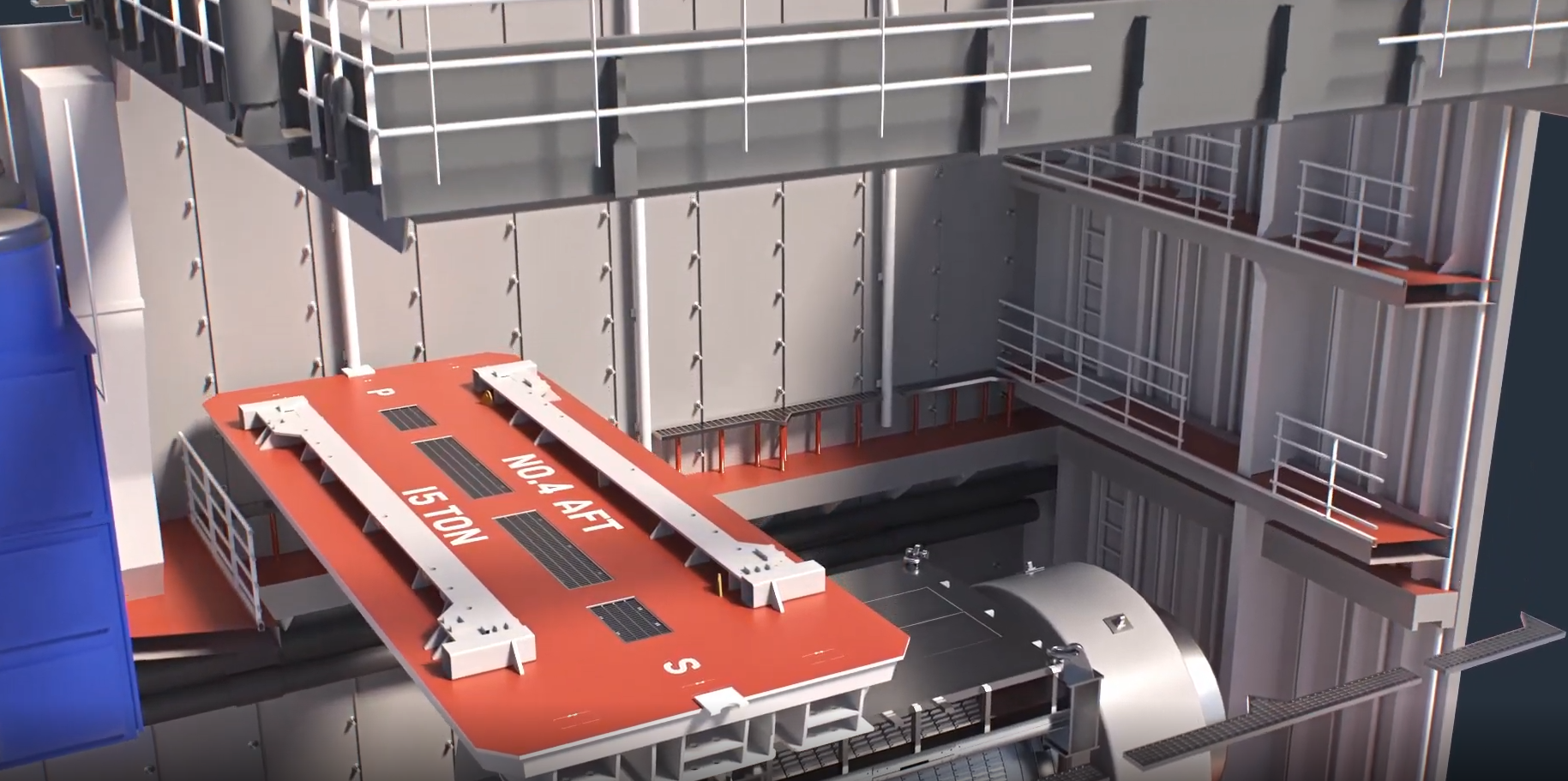
Animated Technologies spiral graphic.

Why Technical Animation Delivers Measurable ROI in 2026

In technical industries like renewable energy, advanced manufacturing, and medical devices, clear visual communication isn't just a marketing preference, it's critical to securing investment, accelerating sales cycles, and ensuring stakeholder understanding. As UK and European companies compete in increasingly complex markets, the ability to explain sophisticated technology quickly and accurately has become a competitive advantage.

High-accuracy 3D technical animation transforms abstract engineering concepts into visuals that decision-makers can immediately understand and act upon. Whether you're a renewable energy start-up seeking Series A funding, an industrial equipment manufacturer entering new markets, or a medical device company navigating regulatory approvals, precision-driven animation has become one of the smartest investments technical companies can make.

This comprehensive guide examines the return on investment (ROI) for technical animation across multiple industries, backed by real-world case studies and measurable outcomes from our work with UK and European technical companies.

Why Precision Matters: The High Stakes of Visual Communication in Technical Industries

The True Cost of Poor Technical Visualisation

In technical environments, a small visual error can cascade into serious consequences. Miscommunication leads to production delays, safety concerns, regulatory pushback, and costly design reworks that could have been avoided with clear, accurate visualisation from the start.

Consider these real-world scenarios we've encountered:

Renewable Energy Sector: A solar technology start-up with genuinely innovative panel design spent eight months pitching to investors using static CAD screenshots and technical diagrams. Despite having superior technology, they consistently lost funding opportunities to competitors with clearer visual presentations. After commissioning a 90-second high-accuracy animation explaining their technology, they secured Series A funding within two months.

Industrial Manufacturing: A UK-based manufacturer of automated production equipment faced 12-16 month sales cycles because prospects needed multiple in-person demonstrations to understand the equipment's value. Physical demos required shipping equipment worth £50,000+ and weeks of logistics coordination. After investing in technical animation, their average sales cycle dropped to 6-8 months, a 50% reduction.

Medical Devices: An orthopedic implant company struggled with regulatory approval timelines because static renders couldn't adequately demonstrate the device's surgical application and biomechanical function. High-accuracy animation showing precise anatomical placement and movement shortened their approval process by four months.

Industries Where Visual Precision Is Non-Negotiable

Technical animation delivers the strongest ROI in sectors where:

  • Renewable Energy & Clean Tech: Solar panel technology, wind turbine engineering, battery storage systems, energy grid optimisation.
  • Industrial Manufacturing: CNC machinery, automated production lines, robotics, material handling systems.
  • Medical & Laboratory Devices: Surgical instruments, diagnostic equipment, laboratory automation, medical imaging technology.
  • Aerospace & Defense: Component assembly, system integration, maintenance procedures, safety protocols.
  • Oil, Gas & Energy: Extraction equipment, refining processes, infrastructure projects, safety systems.
  • Advanced Engineering: Fluid dynamics, mechanical systems, material science applications.

In each of these sectors, the complexity and capital investment involved mean that ambiguity in understanding equals lost opportunities, delayed timelines, and increased costs.

What Exactly Is High-Accuracy 3D Technical Animation?

Beyond Aesthetics: The Technical Requirements

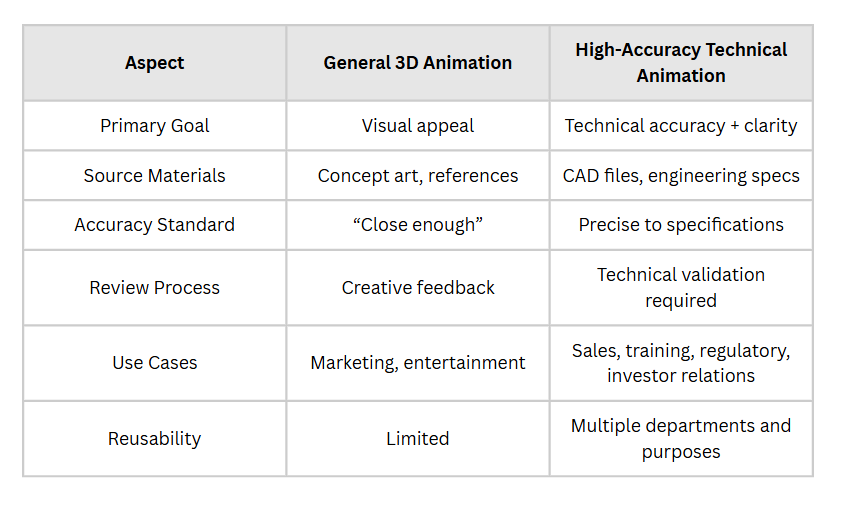
High-accuracy 3D animation for technical industries goes far beyond creating visually appealing content. It's about ensuring every element on screen accurately reflects how real equipment, systems, and processes behave in the physical world.

Core Components of Technical Animation:
  1. Scale Accuracy: Dimensions match real-world specifications to the millimeter.
  2. Physics Compliance: Motion, materials, and interactions behave according to actual physical principles.
  3. Technical Fidelity: Direct integration with CAD files, engineering drawings, and technical specifications.
  4. Functional Precision: Demonstrates authentic system operation, not approximations.
  5. Material Realism: Accurate representation of metals, composites, fluids, and other materials.
  6. Regulatory Compliance: Meets industry standards for technical documentation where applicable.

Technical Animation vs. General 3D Animation: Key Differences

Working with CAD Files and Engineering Data

At Animated Technologies, we work directly with your existing technical documentation:

  • CAD Formats: STEP, IGES, STL, OBJ, FBX, Solidworks, AutoCAD, Inventor.
  • Engineering Specs: Technical drawings, tolerance requirements, material specifications.
  • Scientific Data: Fluid dynamics simulations, stress analysis, thermal performance.
  • Operational Data: Motion paths, assembly sequences, maintenance procedures.

This direct integration ensures your animation doesn't just look accurate—it is accurate.

The ROI Equation: How Quality Technical Animation Drives Measurable Results

Multi-Department Value: One Asset, Multiple Applications

The true ROI of technical animation comes from its versatility. Unlike most marketing expenses that serve a single purpose, a well-executed technical animation becomes infrastructure that delivers value across your entire organisation.

Sales & Business Development:

  • Accelerated sales cycles (typical reduction: 40-60%).
  • Higher proposal acceptance rates.
  • Reduced need for expensive physical demonstrations.
  • Clearer value communication to non-technical decision-makers.
  • Effective tools for remote selling and global market expansion.

Investor Relations & Fundraising:

  • Faster time-to-understanding for potential investors.
  • More confident investment decisions from clearer technology comprehension.
  • Professional presentation materials that enhance perceived innovation.
  • Reusable assets for multiple funding rounds.

Training & Knowledge Transfer:

  • Reduced onboarding time for new technical staff.
  • Improved knowledge retention (visual learning outperforms text-based by 65%).
  • Standardised training materials across multiple locations.
  • Lower overall training delivery costs.
  • Safer training for dangerous or complex procedures.

Product Development:

  • Earlier stakeholder alignment on design direction.
  • Reduced prototype iterations through better visualisation.
  • Faster internal decision-making.
  • Clearer communication between engineering and non-technical teams.

Regulatory & Compliance:

  • Clearer documentation for regulatory submissions.
  • Faster approval processes with better technical communication.
  • Standardised materials that can be updated as regulations evolve.
  • Visual evidence for compliance audits.

Marketing & Communications:

  • Website content that converts technical visitors.
  • Trade show displays that attract qualified leads.
  • Social media content that demonstrates expertise.
  • Sales collateral that actually gets read and shared.

Calculating Your Technical Animation ROI

Step 1: Identify Current Costs of Poor Visualisation

Track these metrics in your business today:

  • Average sales cycle length.
  • Number of in-person demos required per sale.
  • Cost per physical demonstration (travel, shipping, setup time).
  • Training hours required per new employee.
  • Prototype iterations needed before stakeholder alignment.
  • Time spent in clarification meetings explaining technical concepts.

Step 2: Estimate Improvement Potential

Based on our client data across our technical animation projects:

  • Sales cycle reduction: 40-60%.
  • Proposal-to-close rate improvement: 25-40%.
  • Training time reduction: 30-50%.
  • Prototype iteration reduction: 20-35%.
  • Stakeholder meeting time reduction: 40-55%.

Step 3: Calculate Multi-Use Value

List every department and use case for your animation:

  • Sales presentations and proposals
  • Website product pages
  • Investor pitch decks
  • Training modules
  • Trade show displays
  • Regulatory submissions
  • Social media marketing
  • Internal stakeholder communications

Divide total animation cost by number of high-value use cases to understand cost-per-application.

Step 4: Factor in Longevity

Quality technical animation typically remains useful for:

  • Product lifecycle: 2-5 years for most technical products
  • Training purposes: 3-7 years with periodic updates
  • Regulatory documentation: Duration of product approval

Unlike time-limited advertising campaigns, technical animation becomes a long-term asset.

Real ROI Examples from UK Technical Companies

Case Study 1: Renewable Energy Technology Provider

Challenge: 8-month fundraising effort with no success using static presentations Investment: £18,000 for 90-second high-accuracy animation Result: Series A funding secured within 2 months of animation completion ROI: Animation directly contributed to £2.3M funding round

Case Study 2: Industrial Equipment Manufacturer

Challenge: 12-16 month sales cycles, £50K+ per physical demo, limited geographic reach Investment: £25,000 for comprehensive equipment animation suite Result:

  • Sales cycle reduced to 6-8 months (50% reduction)
  • Physical demos reduced from 3-4 per prospect to 0-1
  • Expanded into European markets without physical presence
  • 12 sales in 18 months using animation vs. 5 sales in previous 18 months

ROI: Estimated £400,000+ in increased revenue, £200,000+ in saved demo costs

Case Study 3: Medical Device Start-up

Challenge: Regulatory approval delays, difficulty explaining surgical application Investment: £22,000 for surgical procedure animation Result:

  • 4-month acceleration in regulatory approval
  • Animation also used for surgeon training and sales
  • Secured distribution partnerships in 3 countries

ROI: Earlier market entry worth estimated £500K+ in first-year revenue

Common Challenges When Creating Technical Animations (And How to Avoid Them)

Challenge 1: Working with General-Purpose Animation Studios

The Problem: Many companies make the mistake of hiring animation studios that specialise in marketing or entertainment. While these studios may create visually impressive content, they often lack the technical expertise to ensure accuracy.

Common issues include:

  • Inability to work directly with CAD files
  • Lack of engineering knowledge leading to technical errors
  • Multiple revision cycles because animators don't understand technical requirements
  • Final product that looks good but contains inaccuracies that undermine credibility with technical audiences

The Solution: Work with animation specialists who have proven experience in technical industries. At Animated Technologies, our team includes:

  • Animators with proven experience working with engineering teams
  • Technical reviewers who validate accuracy
  • Experience across renewable energy, manufacturing, and medical sectors
  • Direct CAD file integration capabilities
  • Understanding of industry-specific regulatory requirements

Challenge 2: Unclear Scope and Expectations

The Problem: Technical animation projects can easily expand in scope if objectives aren't clearly defined upfront. Without clear parameters, you may end up with beautiful animation that doesn't serve your actual business needs.

The Solution: Define these elements before project start:

  • Primary use case (sales, training, regulatory, investor relations)
  • Target audience technical level
  • Key technical elements that must be shown
  • Desired length and format
  • Required technical accuracy level
  • Timeline constraints
  • Budget parameters

Challenge 3: Long Review and Approval Cycles

The Problem: When multiple stakeholders (engineering, sales, marketing, legal, regulatory) need to review animation, projects can stall in endless revision loops.

The Solution: Implement structured review process:

  • Designate single technical point of contact
  • Establish review milestones with clear timelines
  • Use storyboard approval before animation begins
  • Conduct technical validation at modeling stage
  • Limit final-stage changes to critical items only

Challenge 4: Balancing Technical Accuracy with Accessibility

The Problem: Animation that's too technical alienates non-expert audiences (investors, customers). Animation that's oversimplified loses credibility with technical reviewers.

The Solution: Create layered communication:

  • Lead with the "what" and "why" before the "how"
  • Use visual metaphors for complex concepts
  • Provide technical detail in supplementary materials
  • Consider creating multiple versions for different audiences
  • Test with representative audience members before finalisation

How to Measure the ROI of Technical Animation for Your Company

Quantitative Metrics to Track

Sales Performance:

  • Time from first contact to proposal submission
  • Time from proposal to close
  • Proposal acceptance rate
  • Average deal size
  • Number of deals requiring physical demonstrations
  • Geographic reach of sales efforts

Training Efficiency:

  • Hours required for technical onboarding
  • Knowledge retention test scores
  • Training material production costs
  • Trainer time required per trainee
  • Safety incident rates in post-training period

Product Development:

  • Stakeholder alignment meeting time
  • Number of design iterations before approval
  • Time from concept to prototype
  • Cross-department communication effectiveness scores

Marketing Performance:

  • Website time-on-page for product pages
  • Video completion rates
  • Lead generation from technical content
  • Trade show lead quality scores
  • Content engagement rates on social media

Qualitative Indicators of Success

Beyond numbers, watch for these positive signals:

Sales Team Feedback:

  • "Prospects understand our value proposition faster"
  • "We're having fewer 'clarification' meetings"
  • "Decision-makers are more confident in their understanding"

Customer & Partner Comments:

  • "Now I see how this actually works"
  • "This is exactly what we needed to understand the technology"
  • "Can we use this animation in our own materials?"

Internal Efficiency:

  • Less time spent explaining concepts to new team members
  • Faster alignment in cross-functional meetings
  • Reduced back-and-forth in email communications about technical details

Competitive Advantage:

  • "Your presentation was much clearer than [competitor]"
  • "We've never seen technology explained this well"
  • Won deals specifically citing communication clarity as differentiator

Setting Realistic ROI Expectations and Timelines

Immediate ROI (0-3 months):

  • Sales teams begin using animation in presentations
  • Website integration improves visitor engagement
  • Trade show displays attract more qualified leads
  • Initial investor or customer presentations show improved comprehension

Short-term ROI (3-6 months):

  • Measurable reduction in sales cycle length
  • First deals closed with animation as key sales tool
  • Training programs integrated with animation showing efficiency gains
  • Regulatory submissions using animation advance through approval process

Medium-term ROI (6-12 months):

  • Cumulative sales impact becomes significant
  • Training cost reductions become evident
  • Animation reused across multiple departments and use cases
  • Market expansion enabled by remote selling capabilities

Long-term ROI (12+ months):

  • Animation continues delivering value across product lifecycle
  • Updated versions created for product iterations at lower cost
  • Company positioned as visual communication leader in sector
  • Animation library becomes competitive advantage

Technical Animation Pricing and Investment Considerations for UK Companies

What Influences Technical Animation Costs?

Project Complexity:

  • Number of components and assemblies
  • Level of detail required
  • Animation duration (typically 60-180 seconds for sales, longer for training)
  • Physics simulation requirements (fluid dynamics, thermal, stress)
  • Photorealistic rendering vs. technical illustration style

Source Material Quality:

  • Availability of CAD files vs. need to model from scratch
  • Technical documentation completeness
  • Engineering support availability
  • Existing reference materials

Timeline Requirements:

  • Standard timeline: 6-10 weeks
  • Expedited delivery: 4-6 weeks (premium pricing)
  • Complex multi-scene projects: 10-16 weeks

Additional Factors:

  • Multiple language versions
  • Various format exports (web, presentation, social, broadcast)
  • Voice-over narration
  • Interactive elements
  • Ongoing update requirements

Typical Investment Ranges for UK Technical Companies

Entry-Level Technical Animation (£8,000-£15,000):

  • 30-60 second animation
  • Single product or system focus
  • Standard CAD file integration
  • Basic physics and motion
  • 1-2 revision rounds
  • Standard delivery timeline

Mid-Range Technical Animation (£15,000-£30,000):

  • 60-120 second animation
  • Multiple components or systems
  • Advanced physics simulation
  • Photorealistic rendering
  • 2-3 revision rounds
  • Includes multiple export formats
  • 6-8 week delivery

Premium Technical Animation (£30,000-£50,000+):

  • 90-180+ second comprehensive animation
  • Complex multi-system integration
  • Advanced scientific visualisation
  • Multiple camera angles and perspectives
  • 3-4 revision rounds
  • Interactive or customisable elements
  • Voice-over and sound design
  • Multiple language versions
  • Priority support and faster delivery

Maximising Your Animation Investment

Bundle Projects for Better Value: Create animation suite covering multiple use cases:

  • 90-second sales version
  • 3-5 minute detailed technical version
  • 15-30 second social media cutdowns
  • Still images for print materials

Plan for Future Updates: Request source files and update rights to enable cost-effective revisions as products evolve

Leverage Across Organisation: Ensure all departments know animation exists and can access it for their needs

Measure and Optimise: Track which versions/styles perform best, refine future animations based on data

Getting Started with Technical Animation: The Animated Technologies Process

Phase 1: Discovery and Technical Assessment (Week 1)

Initial Consultation: We begin by understanding your specific business objectives, target audiences, and technical requirements. This includes:

  • Business goals (sales acceleration, investor relations, training, regulatory)
  • Target audience technical sophistication
  • Existing technical documentation and CAD files
  • Timeline and budget parameters
  • Success metrics and ROI expectations

Technical Review: Our team evaluates your technical materials:

  • CAD file compatibility and quality assessment
  • Technical specification documentation review
  • Identification of key technical elements to highlight
  • Determination of appropriate accuracy level
  • Physics and simulation requirements

Deliverable: Detailed project proposal with scope, timeline, and investment breakdown

Phase 2: Storyboarding and Technical Planning (Week 2-3)

Storyboard Development: We create detailed storyboard showing:

  • Scene sequence and flow
  • Camera angles and movements
  • Key technical details to highlight
  • Timing and pacing
  • Narration or text annotations

Technical Validation: Your engineering team reviews storyboard for technical accuracy before we invest time in full animation production.

Deliverable: Approved storyboard and technical specification document

Phase 3: 3D Modeling and Asset Creation (Week 3-5)

CAD Integration: We import and optimise your CAD files for animation:

  • Geometry clean-up and optimisation
  • Material and texture application
  • Accuracy verification against specifications

Environment Building: Create context and surroundings appropriate for your product:

  • Industrial settings for manufacturing equipment
  • Laboratory environments for medical devices
  • Installation contexts for energy systems

Deliverable: Static 3D models for technical review and approval

Phase 4: Animation Production (Week 5-7)

Motion Development: Animate components according to actual operational mechanics:

  • Accurate motion paths and speeds
  • Physics-based interactions
  • Realistic material behavior
  • Assembly/disassembly sequences

Visual Refinement: Polish visual elements for clarity and impact:

  • Lighting optimisation
  • Camera movement finalisation
  • Color and material refinement
  • Technical annotation addition

Deliverable: Draft animation for review

Phase 5: Review, Revision, and Finalisation (Week 7-9)

Structured Review: Organised feedback process:

  • Technical accuracy verification
  • Communication effectiveness assessment
  • Timing and pacing review
  • Revision implementation

Final Polish: Add finishing elements:

  • Sound design and audio (if applicable)
  • Final color grading
  • Quality assurance review
  • Format optimisation for various platforms

Deliverable: Final animation in all required formats

Phase 6: Delivery and Implementation Support (Week 9-10)

File Delivery: Comprehensive file package including:

  • Master high-resolution file
  • Web-optimised versions
  • Social media formatted versions
  • Presentation-embedded versions
  • Still frames for print use

Implementation Guidance: We help you maximise animation impact:

  • Website integration recommendations
  • Sales presentation templates
  • Training module integration
  • Social media deployment strategy

Ongoing Support: Post-delivery support includes:

  • Technical assistance with file usage
  • Minor revision capability
  • Format conversions as needed
  • Future update planning

Industry-Specific ROI: Technical Animation Applications by Sector

Renewable Energy & Clean Technology Animation

Common Applications:

  • Solar panel efficiency technology demonstrations
  • Wind turbine blade aerodynamics and power generation
  • Battery storage system operation and safety features
  • Energy grid integration and smart technology
  • Carbon capture and storage processes
  • Hydrogen production and fuel cell technology

ROI Drivers:

  • Investor funding acceleration (complex technology made accessible)
  • Regulatory approval support (clear safety and environmental documentation)
  • Market education (new technology adoption requires clear explanation)
  • International expansion (overcome language barriers with visual communication)

Average Results:

  • 50-70% reduction in investor "time to understanding"
  • 3-5x increase in investor presentation success rate
  • 40% reduction in regulatory approval timelines

Industrial Manufacturing Equipment Animation

Common Applications:

  • CNC machinery operation and capabilities
  • Automated production line workflows
  • Robotic system integration and programming
  • Material handling and logistics systems
  • Quality control and inspection processes
  • Maintenance and servicing procedures

ROI Drivers:

  • Remote selling capability (eliminate need for physical demonstrations)
  • Sales cycle acceleration (instant understanding vs. multiple meetings)
  • Global market reach (overcome geographic limitations)
  • Reduced demo costs (eliminate shipping and setup expenses)

Average Results:

  • 45-60% reduction in average sales cycle
  • £30,000-£75,000 saved annually in demo logistics costs
  • 35% increase in qualified international inquiries

Medical Device & Laboratory Equipment Animation

Common Applications:

  • Surgical instrument mechanism and application
  • Diagnostic equipment operation and interpretation
  • Laboratory automation workflows
  • Medical imaging technology functionality
  • Implant design and biomechanical behavior
  • Drug delivery systems and mechanisms

ROI Drivers:

  • Regulatory submission clarity (FDA, CE mark, MHRA approvals)
  • Surgeon and clinician education (faster adoption of new devices)
  • Sales effectiveness (clear value demonstration to hospital procurement)
  • Investment attraction (medtech investors demand clear understanding)

Average Results:

  • 3-6 month acceleration in regulatory approvals
  • 40% increase in surgeon training effectiveness
  • 55% improvement in hospital procurement presentation success

Aerospace & Defense Technical Animation

Common Applications:

  • Component assembly and integration sequences
  • System operation under various conditions
  • Maintenance and repair procedures
  • Safety protocol visualisation
  • Structural stress and performance analysis
  • Mission planning and execution simulation

ROI Drivers:

  • Training standardisation across locations
  • Regulatory compliance documentation
  • Safety improvement through clear procedures
  • Proposal differentiation for competitive bids

Average Results:

  • 30-45% reduction in training delivery time
  • 25% improvement in safety protocol retention
  • Enhanced competitive proposal win rates

FAQ: Technical Animation for UK Industries

How much does high-accuracy technical animation cost for UK companies?

Technical animation investment for UK companies typically ranges from £8,000 to £50,000+ depending on complexity, duration, and technical requirements. Entry-level animations (30-60 seconds, single product focus) start around £8,000-£15,000. Mid-range projects (60-120 seconds, multiple systems, advanced physics) typically cost £15,000-£30,000. Premium animations for complex multi-system integration with photorealistic rendering can exceed £30,000. The investment should be evaluated against multi-department value—sales acceleration, training efficiency, regulatory approval speed, and investor relations impact.

How long does it take to create technical animation for engineering companies?

Standard technical animation projects require 6-10 weeks from initial consultation to final delivery. This includes discovery and technical assessment (week 1), storyboarding (weeks 2-3), 3D modeling (weeks 3-5), animation production (weeks 5-7), review and revision (weeks 7-9), and finalisation (weeks 9-10). Expedited delivery in 4-6 weeks is possible for simpler projects or urgent timelines at premium pricing. Complex multi-scene animations for training or regulatory purposes may require 10-16 weeks depending on technical complexity and review requirements.

What file formats do technical animation companies work with?

Professional technical animation studios like Animated Technologies work with all standard CAD formats including STEP, IGES, STL, OBJ, FBX, Solidworks, AutoCAD, Inventor, CATIA, and Creo. We also integrate engineering specifications, technical drawings, scientific simulation data (CFD, FEA), and operational documentation. Final animations are delivered in multiple formats optimised for different uses: high-resolution master files, web-optimised versions (MP4, WebM), presentation formats (embedded PowerPoint/Keynote), social media formats (Instagram, LinkedIn, YouTube), and still frame exports for print materials.

Can technical animation reduce sales cycles for complex B2B products?

Yes, high-accuracy technical animation typically reduces sales cycles by 40-60% for complex B2B products. This occurs because animation eliminates the "understanding barrier" that extends sales processes. Instead of requiring multiple meetings, physical demonstrations, and lengthy explanations, prospects immediately comprehend product functionality and value. UK industrial equipment manufacturers report reducing sales cycles from 12-16 months to 6-8 months. Medical device companies accelerate hospital procurement processes by 35-50%. Renewable energy companies close investor funding rounds 50-70% faster when using animation versus static presentations.

Is technical animation worth the investment for small manufacturing companies?

Technical animation delivers strong ROI even for small manufacturing companies, particularly when products are complex, high-value, or difficult to demonstrate physically. Small manufacturers benefit through: eliminated physical demonstration costs (£20,000-£50,000+ annually), geographic market expansion without physical presence, faster sales cycles enabling higher transaction volume, improved training efficiency for limited staff resources, and professional positioning against larger competitors. For companies with products valued at £50,000+, annual sales targets of £500,000+, or entering new markets, technical animation typically pays for itself within 6-12 months through accelerated sales and reduced costs.

How does technical animation help with regulatory approvals for medical devices?

Technical animation accelerates medical device regulatory approvals by providing clear, detailed visual documentation that regulatory bodies can quickly understand and evaluate. Instead of requiring extensive written descriptions and multiple 2D diagrams, animation demonstrates device operation, surgical application, patient benefit, and safety mechanisms in easily reviewable format. UK medical device companies report 3-6 month acceleration in CE marking and MHRA approval timelines. Animation also supports FDA submissions, provides standardised materials for multi-country regulatory submissions, and creates reusable documentation that can be updated as regulations evolve—reducing future compliance costs.

What's the difference between technical animation and product visualisation?

Technical animation focuses on functional accuracy and engineering detail, showing how systems actually operate according to specifications. Product visualisation emphasises aesthetic appeal and marketing impact. Technical animation uses CAD files and engineering data as source material, maintains dimensional accuracy, demonstrates realistic physics and motion, serves multiple purposes (sales, training, regulatory), and targets technical and non-technical audiences. Product visualisation uses artistic interpretation, prioritises visual appeal over technical accuracy, focuses primarily on marketing applications, and targets consumer or general business audiences. Many companies need both—product visualisation for marketing, technical animation for sales enablement and training.

Can existing CAD models be used to create technical animations?

Yes, professional technical animation studios work directly with existing CAD models from Solidworks, AutoCAD, Inventor, CATIA, Creo, and other engineering software. CAD file integration significantly reduces animation costs and timelines since geometry already exists and is dimensionally accurate. The animation process includes: importing and optimising CAD geometry, applying realistic materials and textures, creating motion based on operational mechanics, adding environmental context, and rendering with appropriate lighting and camera work. Companies should provide CAD files in native format or universal formats (STEP, IGES) along with engineering drawings, technical specifications, and operational documentation for best results.

How do UK renewable energy companies use technical animation?

UK renewable energy companies use technical animation for investor relations (explaining novel solar, wind, or battery technology to secure funding), regulatory approvals (demonstrating safety and environmental compliance), sales enablement (explaining ROI and installation to commercial customers), market education (teaching new technology benefits to unfamiliar markets), and partnership development (showing integration capabilities to system integrators). Specific applications include: solar cell efficiency mechanisms, wind turbine aerodynamics and power generation, battery storage safety systems, energy grid integration, hydrogen production processes, and carbon capture technology. Animation helps renewable energy companies overcome the "new technology skepticism" barrier by making innovation immediately understandable.

What industries benefit most from high-accuracy 3D technical animation?

Industries with highest technical animation ROI include: renewable energy and clean technology (solar, wind, battery, hydrogen), industrial manufacturing equipment (CNC, automation, robotics), medical devices and laboratory equipment (surgical, diagnostic, research), aerospace and defense (components, systems, procedures), oil, gas and energy (extraction, refining, infrastructure), advanced engineering (fluid dynamics, material science, complex mechanics), and technical product manufacturers serving B2B markets. Common characteristics: complex technology requiring explanation, high product values (£50,000+), long sales cycles, regulatory requirements, investor funding needs, international market expansion, or difficult physical demonstration logistics.

Conclusion: Making the Investment Decision in Technical Animation

High-accuracy 3D technical animation has evolved from a nice-to-have marketing tool to essential infrastructure for UK and European technical companies competing in complex markets. The ROI equation is clear: faster sales cycles, reduced demonstration costs, improved training efficiency, accelerated regulatory approvals, and enhanced investor relations combine to deliver returns that typically exceed 300-500% within the first 12-18 months.

For companies in renewable energy, industrial manufacturing, medical devices, and other technical sectors, the question isn't whether technical animation delivers value—it's whether you can afford to compete without it while your rivals leverage visual clarity as a competitive advantage.

Is Technical Animation Right for Your Company?

Consider technical animation if you answer "yes" to three or more:

  • Your sales team spends 30+ minutes explaining your product in every meeting
  • Prospects frequently say "we love the technology but don't fully understand how it works"
  • You're seeking investment and need to communicate innovation to non-technical investors
  • Physical product demonstrations cost £20,000+ annually or are logistically difficult
  • You're entering new geographic or industry markets where your product is unfamiliar
  • Sales cycles exceed 6 months for products valued at £50,000+
  • Training new employees on complex systems requires 40+ hours per person
  • You operate in regulated industries requiring detailed technical documentation
  • Competitors with inferior technology win deals due to clearer communication
  • Your company has ambitious growth targets requiring sales efficiency improvements

Next Steps: Starting Your Technical Animation Project

Phase 1: Internal Assessment

  • Identify primary business objective (sales, training, investor relations, regulatory)
  • Gather existing technical documentation and CAD files
  • Define target audiences and their technical sophistication
  • Establish budget parameters and timeline requirements
  • Determine success metrics and ROI expectations

Phase 2: Partner Selection

  • Evaluate animation studios' technical industry experience
  • Review relevant portfolio examples from your sector
  • Verify CAD integration capabilities
  • Assess technical expertise of animation team
  • Confirm understanding of your industry's regulatory requirements

Phase 3: Project Scoping

  • Define specific technical elements to demonstrate
  • Establish accuracy requirements and validation process
  • Determine deliverable formats and use cases
  • Set clear timeline with milestone reviews
  • Agree on revision process and approval authorities

Phase 4: Implementation Planning

  • Map deployment across sales, training, marketing, regulatory teams
  • Create measurement framework for tracking ROI
  • Develop integration strategy for website, presentations, social media
  • Plan for ongoing updates as products evolve
  • Establish feedback collection process to optimise future animations

Ready to Explore Technical Animation for Your Company?

At Animated Technologies, we specialise in creating high-accuracy 3D animations for UK and European technical companies across renewable energy, manufacturing, medical devices, and advanced engineering sectors. Our team combines visual expertise with technical understanding to deliver animations that are as accurate as they are compelling.

Whether you're a renewable energy start-up seeking investor funding, an industrial manufacturer expanding into new markets, or an established company looking to accelerate sales cycles and improve training efficiency, we're here to help you visualise your technology with precision and impact.

Contact Animated Technologies today to discuss your technical animation needs and receive a detailed proposal tailored to your specific requirements and business objectives.

About Animated Technologies

Animated Technologies creates high-accuracy 3D technical animations for UK and European companies in renewable energy, industrial manufacturing, medical devices, and advanced engineering sectors. With expertise in CAD integration, engineering visualisation, and technical communication, we help technical companies accelerate sales cycles, secure investment, improve training efficiency, and communicate innovation effectively. Based in the UK and serving clients across Europe, we deliver technical animation that combines precision with clarity—making complex technology immediately understandable to investors, customers, regulators, and employees.